Advertisement
Subway Surfers Unblocked: Everything You Need to Know
Subway Surfers is one of the most downloaded and most-played mobile games in history, and its reputation carries over completely to the browser. Originally developed by Kiloo and SYBO Games, Subway Surfers placed players in the role of a graffiti-tagging teenager named Jake who gets caught in the act by an inspector and his dog, then takes off running through city train stations to avoid capture. What followed was a simple, endlessly replayable loop that hooked hundreds of millions of players worldwide. The browser version you are playing right now delivers that exact experience — no download required, no login, just instant running from the moment you click play.
What made Subway Surfers an instant classic when it launched was the sheer accessibility of its premise combined with the surprising depth hiding beneath it. On the surface, the game is about one thing: run and do not get caught. But once you are inside a run that has lasted longer than you expected, you quickly realize the game is asking a dozen small questions every second. Do you dodge left or right? Do you jump over that train or slide under it? Is that power-up worth changing lanes for? How do you thread through three trains that are suddenly all moving at once? The longer you survive, the more intense those questions become, and the more satisfying it is when you answer them correctly.
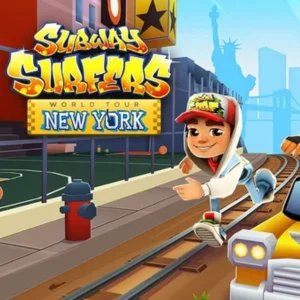
The other thing that kept Subway Surfers at the top of download charts for years was its world-building. The game is set in a rotating cast of real-world cities — from the original train yards to San Francisco, Paris, New York, Tokyo, and dozens more. Each location brings new visual themes, seasonal events, limited-time characters, and unique cosmetic designs for boards and outfits. Even in this browser version, the visual language of the game is immediately recognizable. The vibrant color palette, the kinetic camera angle, and the smooth animations give it an energy that most browser games cannot match.
How to Play Subway Surfers
Playing Subway Surfers requires no tutorial and no warm-up. Your runner launches automatically the moment the game starts, charging down train tracks at a pace that starts fast and gradually gets faster the longer your run lasts. Your only job is to steer, jump, slide, and survive. The controls are minimal by design — and that minimalism is exactly what makes the game work.
The track is divided into three lanes. You move between them by swiping left or right on mobile, or pressing the arrow keys on desktop. You jump by swiping up or pressing the up arrow, and you slide under obstacles by swiping down or pressing the down arrow. Every incoming obstacle requires one of those four inputs, or some combination of them. A train in your lane means you need to switch lanes. A barrier means you jump or slide depending on its height. A low-hanging sign means you slide. A gap in the track means you jump and time your landing. As the game speeds up, these decisions need to be made faster, and the window for error shrinks until a single wrong move ends everything.
Scattered throughout the tracks are gold coins, which are the game's primary currency. You collect them automatically by running through them, and they come in single units, straight lines, and arching patterns that tempt you to deviate from the safest path. The more coins you collect, the more you can spend in the in-game shop on new characters, hoverboards, and upgrades to your power-ups. Alongside the coins are mystery boxes that appear periodically and contain a random selection of keys, hoverboard tokens, and other premium items when you open them.
Controls: Every Way to Play
Subway Surfers is designed to feel natural on every platform. The controls are simple to learn on day one but remain responsive enough to support the precise, split-second inputs the game demands at high speeds.
| Control | Action | Platform |
|---|---|---|
| ← Arrow or A | Move left one lane | Desktop / Laptop |
| → Arrow or D | Move right one lane | Desktop / Laptop |
| ↑ Arrow or W | Jump over obstacles | Desktop / Laptop |
| ↓ Arrow or S | Slide under barriers | Desktop / Laptop |
| Space | Activate hoverboard | Desktop / Laptop |
| Swipe left / right | Switch lanes | Mobile / Tablet |
| Swipe up | Jump | Mobile / Tablet |
| Swipe down | Slide | Mobile / Tablet |
| Double-tap screen | Activate hoverboard | Mobile / Tablet |
| Left-click or tap | Restart / Navigate menus | All Devices |
| Fullscreen button | Expand for best view and reaction time | All Devices |
Arrow keys are slightly more precise than WASD for most players because the layout mirrors the actual directional movement on screen. On mobile, the swipe gestures work best with short, deliberate flicks rather than long sweeps — the game reads the direction of your swipe, not the distance, so economy of motion keeps your hand responsive across multiple obstacles in rapid succession.
Hoverboards: Your Second Chance
One of the features that separates Subway Surfers from other endless runners is the hoverboard system. Hoverboards function as a shield — when you activate one, your runner climbs aboard and becomes temporarily invincible for a short duration. Any collision during that window does not end your run. Instead, the hoverboard absorbs the hit and shatters, leaving you back on foot but still alive. This gives you a meaningful safety net when the speed becomes unmanageable or when an obstacle configuration appears that you could not have anticipated.
Hoverboards come in dozens of different visual designs, each with its own aesthetic but identical gameplay behavior. You equip one before a run starts, and you activate it mid-run either through the spacebar, a double-tap, or the on-screen button depending on your platform. The boards are collected from mystery boxes, earned through weekly hunts, or purchased using coins in the shop. Strategic use of your hoverboard — saving it for the exact moment things are about to go wrong — is one of the clearest differences between a player who lasts a few hundred meters and one who pushes into the thousands.
Power-Ups and Score Boosters
Scattered along the track are floating power-up icons that dramatically change the character of a run when you grab them. Each power-up has a fixed duration that you can extend by upgrading it in the shop using coins. Understanding what each one does — and when grabbing it is worth the lane change — is a core part of mastering the game.
The Jetpack launches you into the air above the tracks entirely, making you immune to ground-level obstacles while automatically collecting coins from the sky. The Super Sneakers give you dramatically increased jump height and distance, letting you clear obstacles that would normally require a slide or lane change. The Coin Magnet pulls every coin in a wide radius toward you, massively boosting your coin haul without requiring you to change lanes for every individual pickup. The Score Multiplier doubles, then triples your score for every meter traveled during its active window, making it the most valuable power-up for leaderboard-chasing players. The Mega Headstart appears before a run begins and launches you deep into the track with a giant score head start — it is particularly useful when you are trying to beat a specific personal best quickly. Each of these can be upgraded to last longer, and upgrading your multiplier is the single highest-return investment you can make if chasing high scores is your goal.
Tips and Tricks to Beat Your High Score
Subway Surfers rewards players who stay calm, plan slightly ahead, and avoid the trap of chasing every coin at the expense of positioning. Here are the strategies that consistently produce longer runs and higher scores.
Tip 01
Stay in the center lane by default. The middle lane gives you access to both sides without committing. Edge lanes cut off one of your escape options the moment an obstacle appears.
Tip 02
Look two obstacles ahead, not one. Reacting to the immediate obstacle is easy at low speed but fatal at high speed. Train your eyes to scan further ahead and plan a path, not just a reaction.
Tip 03
Upgrade the Score Multiplier first. A higher multiplier directly increases every meter you travel. It provides more value per coin spent than any other upgrade if leaderboard performance is your focus.
Tip 04
Save your hoverboard for genuine emergencies. Activating your board too early wastes it on situations you could have survived manually. Save it for obstacle clusters that give you no viable path.
Tip 05
Skip coins that require risky lane changes. A coin in a bad position is not worth the lane change. Coins add to your total, but your run distance is the multiplier that makes them matter.
Tip 06
Use fullscreen mode on desktop. A larger field of view gives you more visual reaction time. The extra screen real estate at higher speeds is a genuine performance advantage, not just a preference.
One pattern that experienced players recognize is the relationship between speed and rhythm. At lower speeds, each obstacle feels like an isolated event. At higher speeds, the track starts to feel like music — a sequence of inputs that flows. Players who reach very high distances are often in a state where their body is responding to patterns before their conscious mind has fully processed them. Getting to that state takes repetition, and every run — even the short ones — contributes to it.
Characters, Outfits, and Unlockables
Jake is the default character you start with, but Subway Surfers features a large roster of additional runners that you can unlock over time. Each character has their own visual design and backstory, and many are tied to specific world tours or limited-time events. Alongside the base characters, most of them have alternative outfits that change their appearance while keeping their gameplay behavior identical. None of the unlockable characters or outfits provide any gameplay advantage — they are purely cosmetic. This is smart design, because it means the playing field stays level regardless of how much time or resources a player has invested.
Characters are unlocked primarily through keys, which are the game's secondary currency. Keys are earned during runs by completing character-specific challenges, found in mystery boxes, or accumulated through daily missions. Some characters require a fixed key cost, while others require collecting a set number of their unique character cards. The card-based system encourages longer engagement because it distributes unlocks across many sessions rather than a single transaction. Outfits for unlocked characters typically require coins rather than keys, making character customization a satisfying ongoing pursuit that gives you something to work toward on every run.
Missions, Challenges, and Daily Goals
Subway Surfers layers several objective systems on top of its core running loop, all of which give you reasons to keep playing beyond simply chasing a personal best distance. The primary layer is the mission system, which assigns you three objectives at a time from a pool that includes targets like collecting a specific number of coins in a single run, traveling a set distance without using a hoverboard, completing jumps or slides, or grabbing a certain number of power-ups. Completing all three missions advances you to the next mission set, which typically has slightly more demanding requirements. This system provides a steady stream of small achievements that make even a short run feel purposeful.
The Weekly Hunt is a rotating limited-time event that tasks you with collecting a specific themed item scattered across the tracks during each run. These items appear alongside the regular coins and power-ups, and collecting enough of them over the week earns you exclusive rewards including hoverboards, characters, and keys that are not available through any other method. The Weekly Hunt is one of the main reasons long-term players return to the game consistently even after they have unlocked most of the permanent content — the rotating rewards always have something new worth chasing.
Why Subway Surfers is Fully Unblocked Here
The version of Subway Surfers hosted here on SnowRider.pro is fully unblocked and accessible on every network including school Wi-Fi, public internet connections, and Chromebook environments. It requires no Flash, no browser extensions, no plugins, and no account creation of any kind. The game runs inside a standard HTML5 browser iframe, which means it loads on any modern device with a web browser: Windows laptops, Mac computers, Chromebooks, Android phones, iPhones, and tablets. Chrome, Firefox, Safari, Edge, and Opera all handle it without issues.
Because the game runs entirely in the browser, nothing is installed on your device and nothing persists after you close the tab. Load time from a typical broadband connection is under three seconds, and the game runs at a smooth frame rate on hardware as modest as a school-issued Chromebook. There are no inappropriate elements — no chat, no user-generated content, no external accounts. It is a clean, skill-based arcade game that any player can enjoy in any environment without restrictions.
Playing Subway Surfers on Mobile and Tablet
Subway Surfers was originally built as a mobile game, so the touch controls in this browser version are particularly well-tuned. Swipe gestures are responsive and accurate, and the game reads short, deliberate flicks correctly even at high speeds. The best practice on mobile is to hold your device in landscape orientation when possible. The game's camera and lane layout benefit from a wider aspect ratio, giving you more time to read incoming obstacles before they reach your runner.
The one area where mobile play requires a slightly different mental approach than desktop is in the precision of small corrections. On a keyboard, tapping an arrow key once produces a single clean lane change. On a touchscreen, a swipe that is too slow or too ambiguous can occasionally register incorrectly. The solution is to keep your swipes short and decisive — one direction, one purpose. Players who adapt to this quickly find that the touch experience in this game is genuinely excellent and in some ways more intuitive than keyboard controls, particularly for the jump-and-slide combinations that become frequent at higher speeds.
Frequently Asked Questions
Is Subway Surfers completely free to play here?
Yes, completely free. There are no paywalls, no premium modes, no in-app purchases, and no subscription fees of any kind. The full game experience is available to every player with no limitations whatsoever.
Do I need to download anything or create an account?
Nothing at all. The game runs entirely inside your web browser using HTML5 technology. No Flash plugin, no app download, no account registration. Open the page and start running immediately.
Does it work on school Chromebooks and restricted networks?
Yes. Subway Surfers on SnowRider.pro is fully compatible with Chrome OS and runs smoothly on school-issued Chromebooks. It does not rely on any blocked technologies and works on most school and public network configurations.
Does the game save my high score between sessions?
Subway Surfers tracks your best score within the current session. For the most consistent tracking, keep the tab open across your runs rather than refreshing the page between sessions.
Is there a maximum distance or score in Subway Surfers?
The track is procedurally generated and effectively infinite — there is no hard distance cap or maximum score built into the game. The run ends only when you crash. Top players have reported scores in the millions across long sessions.
Are there other endless runner games like Subway Surfers available here?
Absolutely. Snow Rider 3D PRO is a top pick for a different kind of endless runner experience set on snowy mountain slopes. Subway Surfers New York offers the same formula in a different city setting. OvO delivers fast-paced parkour running with tight platforming. All are free on SnowRider.pro.
Advertisement
Why Players Keep Coming Back to Subway Surfers
There are thousands of browser games available right now. The overwhelming majority of them are played once and forgotten within the same session. Subway Surfers is a different kind of game, and looking at how it performs compared to other free browser games makes that clear immediately. It has some of the highest return-visit rates and longest average session times of any free online game. The reason comes down to what game designers call the mastery loop — the cycle of playing, failing, learning, and improving that keeps players engaged far longer than any single session of raw entertainment could.
Every time you play Subway Surfers, you get incrementally better. You recognize a new obstacle configuration a fraction of a second sooner. You make a lane change with less hesitation. You learn that a particular cluster of trains always opens up a gap on the right side just after the first one passes. These micro-improvements accumulate across dozens of runs and eventually produce moments where a situation that previously ended your run is now something you navigate without thinking. Those moments feel genuinely rewarding, and they keep pulling you back for the next run where you test whether that improvement holds.
It also helps immensely that each individual run is short enough that restarting never feels like a punishment. A run that lasts thirty seconds is not a failure — it is a data point. The game communicates this through its instant restart mechanic. The moment you crash, a button appears that lets you go again immediately. No death animation. No loading screen. No wait. Just one click and you are back at full speed. That frictionless loop is one of the most important pieces of design in the entire game, and it is exactly why a five-minute break can quietly turn into forty-five minutes before you notice. Play Subway Surfers right now using the game window above this page. No sign-up, no download, no waiting — just click the iframe and swipe to start.
More Games You Will Love
View All Games















Advertisement